

Contact us
Free · We reply within 15 minutes
Danh mục
More
Contact us
Free · We reply within 15 minutes
Buying Guide
Updated August 2026 · By the LongDenViet workshop, Ho Chi Minh City
Ask five different stalls in Hoi An what a lantern costs and you will get five different answers. That is not a scam so much as it is how a night market works — prices flex with foot traffic, the hour, and how many other lanterns you are buying at once.
This page skips the guessing. Below are the real prices we charge from our workshop in Ho Chi Minh City, broken down by size and style, plus an honest look at why a lantern in one shop can cost three times as much as the same size somewhere else.
We keep this page updated because the questions we get on WhatsApp are always some version of the same thing: is this price fair, and what am I actually paying for. The short answer is that four variables decide almost every dong of the number — size, fabric, hand-finishing and bamboo quality — and every table below is broken down by exactly those variables, not by guesswork.
Plain silk shapes share one table. Disc, umbrella, hand-painted and embroidered styles each cost a little more.
These are workshop prices in Vietnamese dong (VND), not a market estimate. Plain silk lanterns in the round, inverted-garlic, banh-u, diamond and custard-apple shapes all share the same size-based table:
The flying-saucer (disc) shape takes more folding, so it costs a little more at the same diameter:
The umbrella shape sits above that again, since the pleats are more intricate:
Hand-painted lanterns cost the most of the plain-frame styles, because every one is painted by a person rather than printed:
Embroidered lanterns for Hoi An or Tet run a flat 160,000 VND regardless of the character stitched on the fabric, with one exception — the Hoa Mai (apricot blossom) design costs 240,000 VND for the extra stitching. Patterned-fabric Hoi An lanterns, printed rather than plain silk, run 30,000–80,000 VND depending on size.
In USD, roughly
The dong figures above convert to somewhere between 1 USD (a small 10 cm plain lantern) and 70 USD (a full 100 cm hand-painted piece), depending on the day's exchange rate. We always quote the exact VND price on WhatsApp before you commit to anything.
Seeing the four tables as bar charts side by side makes the pattern obvious: every style follows the same curve as diameter increases, but the curve sits higher the more hand labour a shape or finish demands. A 40 cm plain silk lantern and a 40 cm hand-painted lantern share a frame and roughly the same amount of fabric — the price gap between them is almost entirely the hours a painter spent on it.
It also helps to notice how the plain-silk curve behaves at the top end. Prices rise steadily from 10 cm to 60 cm, then step up sharply from 60 cm to 70 cm and again toward 100 cm. That jump is not arbitrary — past roughly 60 cm the bamboo ribs need to be thicker and more carefully matched to hold their shape without sagging, and the silk panels are cut from wider bolts of fabric with more waste per lantern. The workshop is not charging more per centimetre out of preference; the materials genuinely behave differently at that scale.
One thing that does not change the number: the season. A workshop price stays the same in a quiet week in March as it does during the run-up to Trung Thu or Tet, when demand for lanterns in Vietnam climbs and market-stall prices tend to firm up. That consistency is one of the practical advantages of buying factory-direct rather than from a seasonal stall — you are not competing against holiday demand for the same fixed number.
Both are legitimate ways to buy — they just work differently.
A night-market stall in Hoi An sells the same craft, but the price is not fixed. It moves with how busy the stall is, how many lanterns you are buying, and whether you are willing to walk away and come back. Some visitors enjoy that back-and-forth; others find it stressful, especially with a language barrier.
A workshop price is fixed instead. What we quote on WhatsApp is what you pay — no haggling, no different price for the next customer in line. Neither approach is wrong. If you like markets, go enjoy one. If you would rather know the number up front, that is what this page is for.
One practical tip if you do choose to shop at a stall: walk the market once before buying anything. Prices for the same size and shape can vary two or three times over between stalls aimed at tourists and stalls aimed at locals restocking for a festival. A quick lap costs you ten minutes and tells you the going rate for that evening.
It also helps to know what you are actually negotiating over. In a market, you are haggling over the seller's margin on a single transaction — there is no catalogue behind it, no guarantee the next lantern from the same stall will be identical. In a workshop relationship, the fixed number already reflects the true production cost plus a consistent margin, which is why repeat wholesale buyers rarely try to negotiate it down further — there is very little slack left to negotiate against, and the trade-off is a number you can plan a budget around months in advance.
Neither buyer is wrong to prefer one model over the other. A one-time tourist purchase of two or three lanterns is a very different transaction from a hotel ordering two hundred for a lobby renovation, and the right pricing model follows from that difference, not from which one is somehow more legitimate.
Four things decide the number, and none of them is a mystery.
None of these four factors is hidden or unusual — they are the same variables that set the price of any handmade textile object, from a woven basket to a hand-embroidered garment. What makes lantern pricing feel confusing to a first-time buyer is simply that all four can vary independently within the same shape and size, so two lanterns that look almost identical on a stall table can carry genuinely different, both fair, prices.
Hoi An has been a working port and craft town since roughly the sixteenth and seventeenth centuries, when it traded silk, ceramics and spices with Chinese, Japanese and later European merchants. The lantern craft that survives today grew out of that trading history, and the town’s old quarter was recognised as a UNESCO World Heritage Site in 1999 largely because so much of that architecture and craft tradition is still intact. None of that history changes what a lantern costs — but it is worth knowing that the skill behind the frame in front of you traces back centuries, not decades.
The size that looks right in a photo is not always the size that reads right on your wall.
Price and physical scale move together, so it helps to think about where a lantern is going before comparing numbers on a table. A 10–20 cm lantern at the bottom of the price ladder is a gift or a shelf piece — buying a 60 cm lantern for that same spot means paying for size a small room will never show off. Equally, a 100 cm lantern is wasted hung somewhere it cannot be seen from a distance.
If you are buying several lanterns for one room — a cluster over a dining table, a row along a terrace — it is usually cheaper overall to mix two or three sizes than to buy several of the largest size. A staggered cluster of a 45 cm, a 40 cm and a 35 cm lantern reads as more considered than three identical 45 cm pieces, and the total spend is lower.
There is also a point of diminishing visual return worth knowing before you pay for the next size up. Once a lantern is large enough to be seen clearly from across the room — usually somewhere around 45–60 cm depending on ceiling height and lighting — going bigger again mostly adds price, not visible impact, unless the space itself is large enough to need it, such as a double-height lobby or an outdoor terrace viewed from a distance. If you are unsure which size reads right in your specific room, send us a photo on WhatsApp with rough dimensions and we will suggest a diameter rather than let you guess.
Freight is quoted separately, and the fold-flat design is what keeps it reasonable.
Every table above is the lantern price alone. If you are buying in Vietnam and packing it in your own luggage, that number is the whole story. If you want it shipped to you internationally, freight is the second line item, and it is quoted separately because it depends on your destination country, not on us.
What keeps international shipping realistic at all is the fold-flat frame. A traditional bamboo-and-silk lantern collapses to a few centimetres thick and weighs a fraction of what a rigid object the same size would. The table below is the actual folded weight by diameter for our standard plain-silk range — the number a courier bills against.
For a domestic order inside Vietnam, freight is inexpensive and often folded into the total quote without a separate line. For international orders, we ask for your destination country and total quantity and include the DHL or FedEx estimate in the same quote as the lantern price, so you see the real landed cost before you pay anything — not a surprise once the package clears customs.
Weight is only half of what a courier bills against — dimensional (volumetric) weight matters too, which is calculated from the size of the box rather than the actual weight inside it. This is exactly where the fold-flat design pays off twice over. A box of ten folded 40 cm lanterns is barely thicker than a stack of dinner plates, so it clears the volumetric-weight threshold that would apply to almost any other handmade decorative object of the same visual size. That is a large part of why shipping a lantern internationally is realistic at all, and why a rigid equivalent souvenir of the same diameter would cost noticeably more to freight.
Customs duties and import taxes sit on top of both the lantern price and the freight cost, and they are set entirely by your destination country — we have no influence over that number and we do not attempt to undervalue a shipment to reduce it. Declaring goods accurately is standard practice and it is also what keeps a package from being held or delayed at customs, which costs everyone more time than the duty itself.
For weddings, restaurants, hotels or resale, the per-piece price is not the retail figure above.
If you need enough lanterns to decorate a venue, stock a shop, or supply a hotel lobby, message us with the quantity, sizes and shapes you are after. We put together a wholesale quote based on what you actually need — there is no fixed bulk-discount percentage published here, because it depends on the order.
The retail tables above are still the right reference point for what a single piece costs at each size. A wholesale quote starts from that same per-piece number and applies a quantity tier on top of it — it is not a separate, unrelated price list. See our full wholesale guide for how the tiers work and what quantities trigger each one.
The single most common mistake we see from first-time bulk buyers is pricing an order purely off the retail table without asking for a quote. Wholesale tiers exist precisely because per-unit cost drops as quantity rises — a fifty-piece order priced at the retail rate will always overstate what you actually end up paying, sometimes by a wide margin. It costs nothing to ask before you budget a project around a number that was never going to be the final one.
The biggest risk is not price — it is buying printed fabric sold as silk.
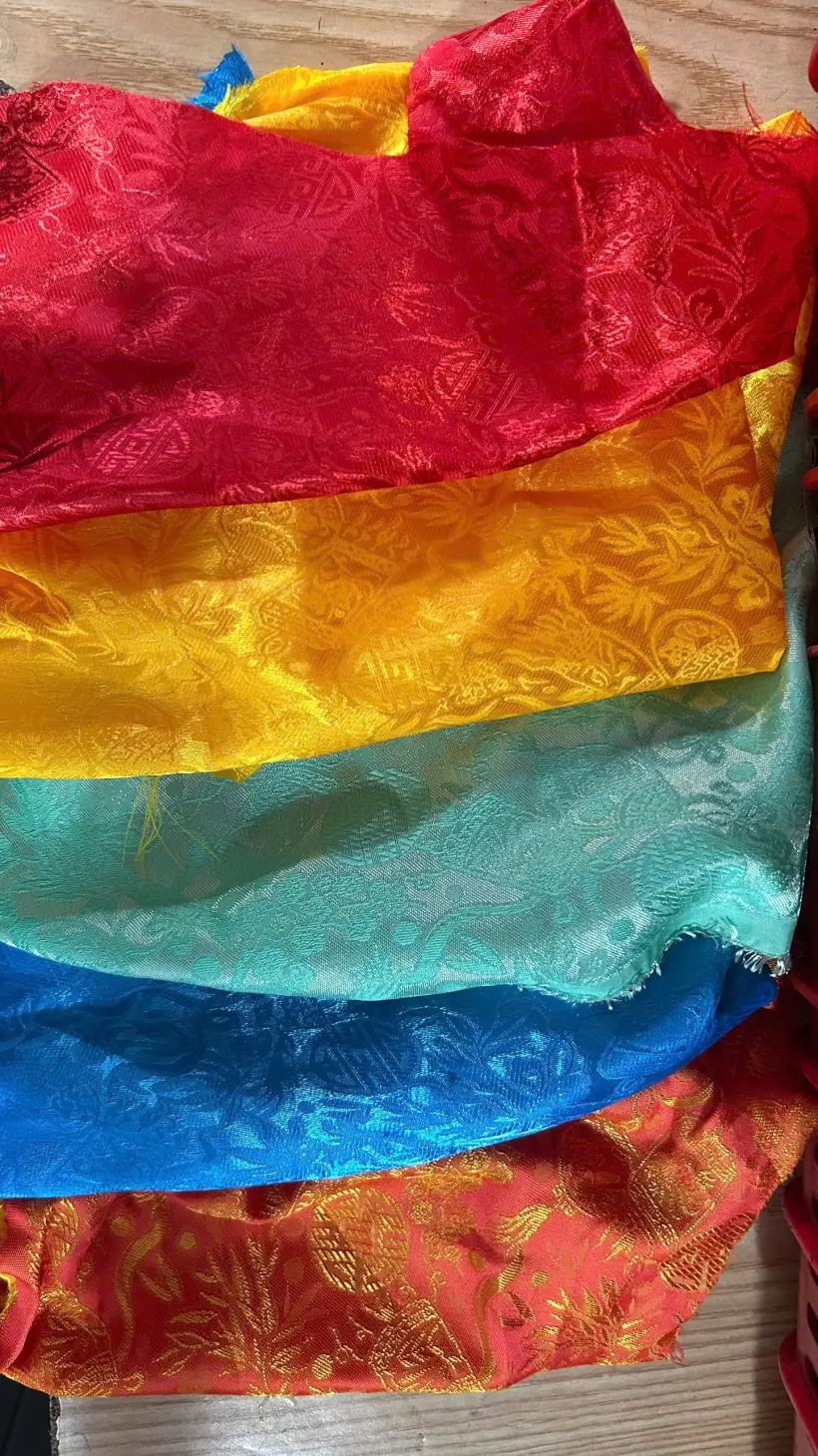
The most common way tourists overpay is not a high price tag — it is paying a silk-lantern price for a printed-fabric lantern. Real silk has a slight natural sheen and a soft, uneven texture under light; printed synthetic fabric tends to look flatter and more uniformly glossy. If a stall quotes a price well above our silk table for what looks like a printed pattern, ask directly whether it is silk or printed fabric before paying.
Beyond that, comparing against the workshop table above is the simplest check. If a price is wildly out of line for the size and style, ask what makes it different — hand-painted work, an unusually large frame, real silk versus printed fabric are all fair reasons for a higher number.
A second, quieter risk is the frame rather than the fabric. A lantern can be genuine silk over green, poorly dried bamboo — it will look identical on the shelf and warp or crack within a season. There is no visual test for this at point of sale; the only real protection is buying from a source you can go back to if something goes wrong, which is one reason we sell factory-direct rather than through a chain of resellers.
A third, less obvious way to overpay is buying the wrong size for the job. A lantern priced fairly for its diameter is still an overpay if it is too small to read as anything from where it hangs, or too large for a space that never needed that much presence. Reviewing the size-versus-space guide above before you settle on a diameter protects your budget just as much as checking the fabric does — it is simply a different kind of overpaying, spending correctly on the wrong number.
Finally, ask about the frame material specifically if you are buying for permanent outdoor display rather than a short trip or an indoor room. Bamboo frames are the traditional, lightest and most affordable option, built for indoor use or short-term outdoor decoration. For a courtyard, terrace or entrance that stays lit year-round, a powder-coated iron frame with a weather-resistant fabric such as brocade costs more up front but avoids paying to replace a bamboo frame that was never meant for constant sun and rain.
A fair question to ask any seller
If a price feels high for the size and shape in front of you, simply ask what makes it different — hand-painting, real silk versus printed fabric, or an unusually large frame are all legitimate reasons. A seller who cannot answer that question clearly is the clearest warning sign of all.
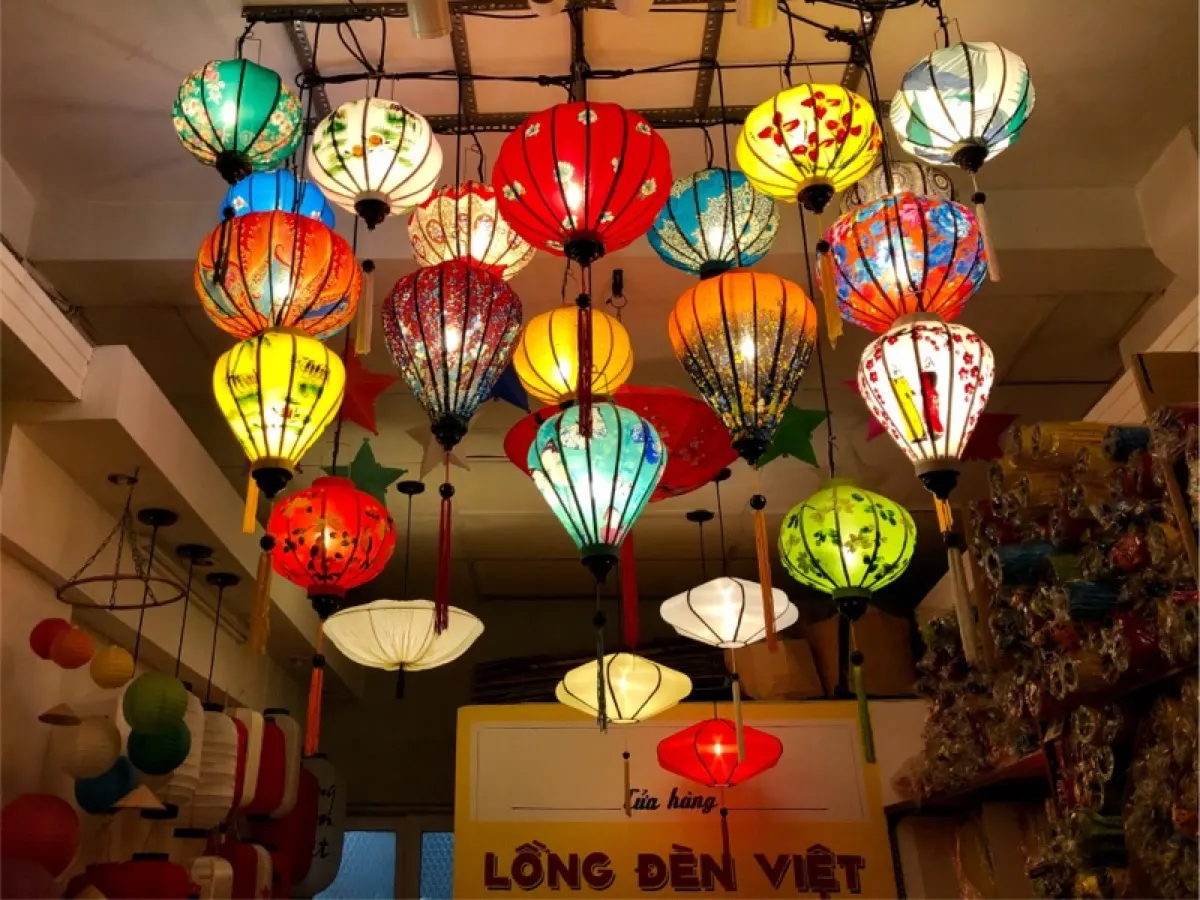
Handmade bamboo-and-silk lanterns from our Ho Chi Minh City workshop, priced the same as the tables above.


How much do lanterns cost in Vietnam?
Plain silk lanterns run from 30,000 VND for a 10 cm size up to 900,000 VND for a full 100 cm piece. Flying-saucer, umbrella, hand-painted and embroidered styles cost more at the same size — see the tables above for the exact figures.
How much should I pay for a lantern in Hoi An?
If it is a plain silk lantern, our workshop table is a fair reference point: 30,000 VND at 10 cm up to 900,000 VND at 100 cm. Night-market prices flex with negotiation, so use the table as your baseline before you haggle.
How much are Vietnamese lanterns?
It depends heavily on size and style. Small plain silk lanterns start around 30,000 VND; large hand-painted pieces can reach 1,800,000 VND. Embroidered Tet and Hoi An lanterns are a flat 160,000 VND (240,000 VND for the Hoa Mai design).
Why do prices differ so much between shops?
The four biggest factors are size, whether the fabric is real silk or printed synthetic, whether the design is hand-painted or embroidered rather than plain, and the quality of the bamboo frame. A shop charging more for what looks like the same lantern is usually charging for one of these.
Do you offer wholesale prices?
Yes. Message us the quantity, sizes and shapes you need for a wedding, restaurant, hotel or resale order, and we put together a wholesale quote based on the actual order — there is no fixed published bulk discount.
Why is a flying-saucer or umbrella lantern more expensive than a round one at the same size?
The frame geometry takes more work to build and fold. A flying-saucer profile is wide and flat, which needs more careful rib tension to fold cleanly; an umbrella shape has pleated panels that take longer to assemble. Both cost a little more than the plain round, garlic-bulb, banh-u, diamond and custard-apple table at the same diameter.
Is it rude to negotiate the price at a Hoi An lantern stall?
No — gentle negotiation is a normal part of night-market shopping in Vietnam, not something that offends a stallholder. Walking the market once before buying, and comparing what you are offered against our fixed workshop table, gives you a fair reference point to negotiate from.
Does the price include shipping?
No — every table on this page is the lantern price alone. Domestic delivery within Vietnam is usually inexpensive and often folded into a quote without a separate line; international shipping via DHL or FedEx is quoted separately once we know your destination country and total quantity, since courier rates vary by country and by weight.
Are prices higher during Tet or Trung Thu?
Not from our workshop — the tables above stay the same year-round. Night-market stalls in Vietnam can firm up their prices during the run-up to major festivals when local demand for lanterns rises, which is one practical reason buyers who want price certainty during those seasons choose a fixed workshop quote instead.
Continue reading
Send us the size, shape and colour on WhatsApp and we confirm the VND price before you pay anything — no haggling, no surprises.
Visit our showroom
262/1/93 Phan Anh, Phu Thanh Ward, Tan Phu District, Ho Chi Minh City
Air-conditioned, one-on-one help, English spoken. Open daily 8 a.m.–9 p.m.