

Contact us
Free · We reply within 15 minutes
Danh mục
More
Contact us
Free · We reply within 15 minutes
Travel & Shopping
Updated June 2026 · By the LongDenViet workshop, Ho Chi Minh City
Wondering where to buy lanterns in Hoi An? You came for them — everyone does. The whole old town glows after dark, and somewhere between the river and the night market you decide you have to take one home.
The catch is that not every lantern on sale is the same. Some are made the traditional way — aged bamboo, real silk, hand-tied ribs. Others are cheap factory copies that fade and sag within a season. This guide walks you through where to look, what a fair price is, how to tell good from bad, and what to do if you want a proper one shipped to your door.
It also covers a question almost nobody asks until they are standing at the stall with a lantern in each hand: which shape and which size, for the space you actually have back home. A 20 cm round lantern on a shelf reads completely differently from a 60 cm one over a dining table, and picking the wrong one is the most common regret we hear about after a trip.
Three zones, each with a slightly different feel and price.
This is where most travellers start, and for good reason. From around 6 p.m., the stalls along the An Hoi night market light up with lanterns of every shape and colour. Seeing them lit is half the point — silk only shows its true tone when there is a bulb behind it. Prices here are the most negotiable in town, so this is the place to bargain.
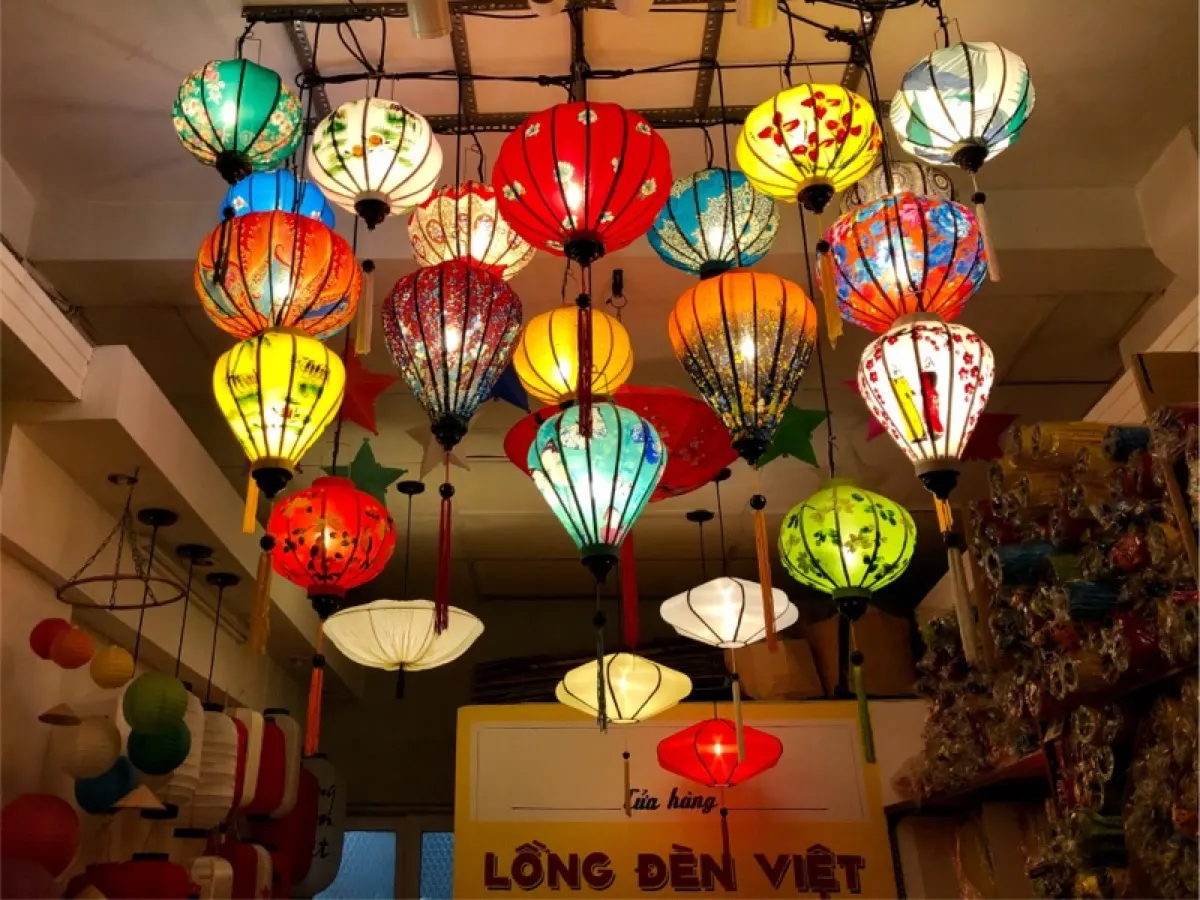
Running along the river next to the night market, this pedestrian stretch is the photo everyone has seen: hundreds of lanterns strung overhead. There are stalls here too, slightly more curated than the market proper. Good for browsing shapes you will not find at home — garlic, diamond, the umbrella-style ones with the flared rim.
Cross the bridge into the old town and the small workshops appear. This is where you find the higher end: tighter weaving, better silk, embroidered or hand-painted pieces. Prices are firmer because the quality usually justifies them. If you want a lantern that will still look good in five years rather than five months, this is the area to spend your time.
A fourth, quieter option worth knowing about: a handful of workshops sit a short walk back from the river, away from the main flow of foot traffic. They tend to have less inventory on display but will happily open a lantern, show you the rib count, and talk you through the difference between a dip-dyed silk and a printed one. If you have the time, ask a stallholder in the busy zones to point you toward the workshop they buy from — most are happy to.
A rough map so you know when a price is fair and when you are being quoted the tourist rate.
Most handmade lanterns in Hoi An fall between 100,000 and 500,000 VND — roughly 4 to 22 USD — depending on size, fabric and how intricate the work is. A small silk lantern is at the lower end; a large embroidered or hand-painted piece sits near the top.
Bargaining, lightly
At the night market a first quote is usually a fair bit above the selling price. Smile, counter once, and meet somewhere in the middle. In the artisan workshops there is far less room to haggle — you are paying for the craft, not the markup.
It helps to know what a fair price looks like from the other side of the counter, too. Below is our own factory-direct price ladder for plain silk lanterns by size — the same range of construction you will see on the stalls, minus the tourist mark-up that a street price sometimes carries.
A stall price near this range, for a lantern that passes the quality checks below, is a fair deal. A price well above it for a lantern that fails those checks is the one to walk away from — politely, there is always another stall.
The stall has more choice than you think — deciding at home saves time at the counter.
Most visitors arrive with no plan and pick whatever catches the eye under the stall lights, which is a perfectly good way to buy one lantern as a keepsake. It is a worse way to buy several for a specific spot at home, because shape and size both change how a lantern behaves once it is hanging somewhere with daylight instead of festival lighting all around it.
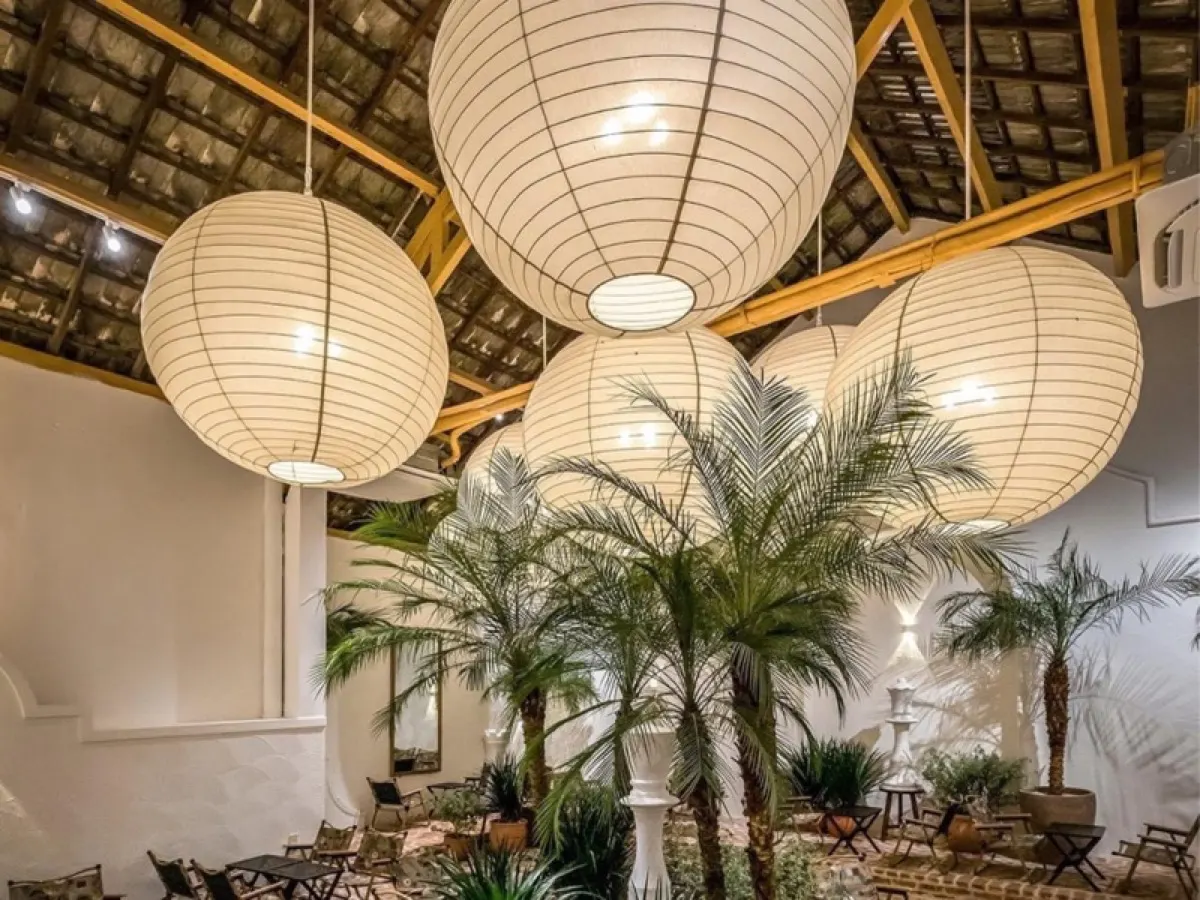
Round is the shape most people picture and the easiest to mix with anything. The inverted-garlic and custard-apple shapes read a little more traditional and pair well in odd-numbered clusters. Diamond and banh u (pyramid) shapes throw a more angular shadow, which some travellers like for a modern room. The flying-saucer and umbrella shapes are wider than they are tall — good for low ceilings, since they do not hang as far down.
A useful trick at the stall: hold the folded lantern next to your forearm before it is opened. Roughly elbow to wrist is close to 30 cm, elbow to fingertip closer to 45 cm. It is not precise, but it beats guessing, and it means you are not opening and re-folding six lanterns while the stallholder waits.
Colour is the other decision most people make on instinct, which is fine for one lantern but worth slowing down for on a set. Warm tones — red, amber, deep yellow — read as festive and traditional, and they photograph well against Hoi An's ochre walls, which is part of why so many travellers gravitate toward them. Cooler tones like blue or green sit further from the classic look but work well in a modern interior back home, especially against white or grey walls where a red lantern can feel like it is competing rather than complementing.
If you are buying more than three or four pieces for one wall or one room, picking a single family of colour — three shades of amber and gold, say, rather than one of every colour on the stall — nearly always looks more considered once they are hung side by side. It is a small decision at the counter that makes a real difference at home.
Four checks you can do in thirty seconds at the stall.
These are the same things a workshop checks before a lantern leaves the bench: even ribs, treated bamboo, real silk pulled tight with no wrinkles. Get those right and the colour, the shape and the price all start to make sense.
A fifth check, less obvious but worth doing if you can: smell it. Properly seasoned bamboo has almost no smell, or a faint, dry, woody one. Green bamboo that has been rushed through drying often carries a slightly damp, grassy note, and it is more prone to mould once it sits in a humid climate back home. It is a small detail, but stallholders who make their own pieces will not mind you checking — they know it is a fair question.
Colour is worth a second look, too. Traditional dyed silk has a slight variation in tone across the surface — a natural result of hand-dipping — rather than one flat, uniform colour. A printed synthetic fabric often looks perfectly even, almost too perfect, and under strong light you can sometimes see a faint dot-matrix pattern from the printing process. Neither is a dealbreaker on its own, but taken together with stiffness and rib quality, it tells you what you are actually paying for.
The clever part of the Hoi An design: it folds flat.
This is the question every traveller eventually asks at the stall, and the answer is genuinely yes. The traditional Hoi An lantern is collapsible. Press the top ring gently inward and the whole thing folds down to the size of a dinner plate — flat enough to slide between clothes in a suitcase. At home it opens out again like an umbrella in under a minute.
Slip it into a bag so the silk does not snag, keep it away from anything that can crush the rim, and it travels fine in checked or even carry-on luggage. We wrote a full walkthrough on folding, packing and shipping if you are buying several or want to be sure.
One caution: not every lantern on sale folds cleanly. Cheaper synthetic-fabric copies sometimes use a stiffer wire frame that does not spring back into a perfect round after folding — it comes home slightly out of shape. This is one more reason the quality checks above matter before you buy, not after you have unpacked at home and found a lopsided lantern.
Both sell the real thing. The difference is quantity, certainty, and how much time you have.
For one or two lanterns as a souvenir, the market is hard to beat — you see it, you feel it, you carry it out that evening. For anything beyond that, the trade-offs shift.
The two are not mutually exclusive, either. Plenty of visitors buy one or two favourites at the market as souvenirs, then message a workshop for the rest of a project once they know exactly which shape and colour they liked.
Plenty of travellers fall for the lanterns and then run out of time, or want a matching set for a restaurant or wedding back home.
If your itinerary skips Hoi An, or you want twenty matching pieces rather than the two that fit in your bag, buying direct from a Vietnamese workshop solves both. We are LongDenViet, a lantern workshop based in Ho Chi Minh City making the same bamboo-and-silk lanterns in eight shapes, fourteen colours, and sizes from 10 cm to over a metre.
We ship internationally via DHL and FedEx, and because the lanterns fold flat the freight stays reasonable. You can browse the full range on our English page, or message us on WhatsApp with what you saw in Hoi An and we will match it.
Prefer to make one yourself rather than buy it? In Hoi An you can join a hands-on Hoi An lantern-making class — build your own silk lantern with a local artisan and take it home the same day.
Whichever route you take — a stall on the night market, a small workshop in the artisan quarter, or an order shipped after you land home — the lantern that lasts is always the same one: aged bamboo, real silk, evenly split ribs, and a bottom ring that holds its shape after the fold. Everything else is a matter of taste.
The same bamboo-and-silk lanterns you see in the old town — handmade, foldable, and shipped worldwide. Prices shown are retail; ask us for wholesale.


Which lantern shop in Hoi An should I buy from?
There is no single shop to name: the Ancient Town stalls and the night market all sell the same handmade shapes, and quality varies stall by stall rather than street by street. Judge the piece, not the shopfront — check that the frame is bamboo rather than plastic, that the silk is stitched instead of glued, and that the lantern folds flat cleanly. For one or two souvenirs, buy where you can see it lit. For a matching set or shipping abroad, order from a workshop that quotes in writing.
What is the best time of day to buy lanterns in Hoi An?
After dark, from around 6 p.m. Lanterns only reveal their true colour when lit, so the night market is both the prettiest and the smartest time to shop. You can compare tones side by side instead of guessing in daylight.
Are Hoi An lanterns foldable for travel?
Yes. The traditional design collapses flat — you press the top ring inward and it folds to roughly the size of a plate, then opens out again like an umbrella. They pack easily into a suitcase or backpack.
How much does a lantern cost in Hoi An?
Most handmade lanterns cost between 100,000 and 500,000 VND (about 4 to 22 USD), depending on size and fabric. Embroidered or hand-painted pieces go higher. At the night market the first quote is usually negotiable.
Can I buy Hoi An lanterns online and have them shipped abroad?
Yes. Vietnamese workshops, including ours, ship the same handmade lanterns worldwide via DHL or FedEx. Because they fold flat, shipping is affordable even for larger orders. Message us with quantity, size and colour for a quote.
What shapes of lantern can I buy in Hoi An?
The classic set includes round, inverted garlic, banh u (pyramid), diamond, custard apple, flying saucer and umbrella shapes. Round is the most versatile for mixed decor; the flying saucer and umbrella shapes hang lower profile and suit rooms with a lower ceiling.
Should I buy at the night market or order from a workshop?
For one or two souvenir pieces, the night market is simplest — you see it lit, pick it, and carry it home that evening. For a matching set of ten or more, or for international shipping with a fixed quote, ordering directly from a workshop is more reliable and usually the better value.
Do all Hoi An lanterns fold flat, or only some?
The traditional bamboo-and-silk construction folds flat by design. Some cheaper synthetic copies use a stiffer frame that does not spring back into a perfect round after folding. Checking that a lantern opens back out evenly, before you buy it, is the simplest way to avoid this.
Continue reading
We make traditional bamboo-and-silk lanterns in eight shapes and fourteen colours, and ship them flat-packed worldwide via DHL and FedEx. Tell us what you are after and we will match it.
Visit our showroom
262/1/93 Phan Anh, Phu Thanh Ward, Tan Phu District, Ho Chi Minh City
Air-conditioned, one-on-one help, English spoken. Open daily 8 a.m.–9 p.m.