
Contact us
Free · We reply within 15 minutes
Danh mục
More
Contact us
Free · We reply within 15 minutes
Culture & Symbolism
Updated June 2026 · By the LongDenViet workshop, Ho Chi Minh City
Vietnamese lantern meaning goes far deeper than decoration. The colour you choose, the shape you hang, even the room you put it in — each carries symbolism that stretches back centuries, through trading ports, temple ceremonies and full-moon festivals.
This guide explains what that meaning actually is: the symbolism behind each colour, what the different shapes say, how the Hoi An silk lantern came to be, and how to use all of this when choosing a lantern for your home or business. Nothing here is invented — it is drawn from the cultural and craft knowledge our workshop has worked with since 2016.
Light as an invitation, a wish, and a bridge.
In Vietnamese belief, a lit lantern is an active thing. Light represents Yang energy — warmth, vitality, forward motion. Hanging a lantern is not passive display; it is an invitation. You are asking that good energy to enter, to settle, to stay.
Traditionally, lanterns appeared most visibly at festivals and on the full moon. The fifteenth day of each lunar month, when the moon is brightest, was the occasion to carry lanterns through the streets, float them on rivers and hang them at doorways. The light was understood as a signal — to ancestors, to protective spirits, to the forces that govern luck and wellbeing — that this household was awake and welcoming.
Tết, the Vietnamese New Year, is the most lantern-dense moment of the calendar. Red and yellow glow from shop fronts, pagoda gates and family altars. Businesses hang lanterns at entrances not merely for atmosphere but with intention: the light is meant to draw in prosperity for the year ahead.
That ceremonial origin has not disappeared — it has expanded. Today lanterns are everyday interior objects in homes, cafés, restaurants, hotels and wedding venues across Vietnam and far beyond. The meaning travels with them. When you bring a silk lantern into a space, you bring what it represents: warmth, welcome, a quiet wish for good fortune.
The feng shui angle
In East Asian belief, lantern light represents Yang energy — it brings vitality and warmth to any room. This is why businesses often hang red lanterns right at the entrance: the lit lantern activates positive energy at the threshold, the first point a customer or guest crosses.
A handful of moments in the lunar calendar carry more lantern symbolism than the rest of the year combined.
The lantern's meaning is not spread evenly across the calendar. It concentrates around a small number of lunar dates, each with its own reason for the light. Knowing when these moments fall helps explain why certain colours and quantities of lanterns appear where they do, and it is useful if you are timing a display, a gift or a visit around one of them.
Tết Nguyên Đán, the lunar New Year, is the single biggest lantern moment of the year — red and yellow lanterns appear at shopfronts, pagoda gates and family altars in the days leading up to it, meant to draw prosperity into the year ahead. Two to three weeks later, Rằm tháng Giêng, the first full moon of the new lunar year, is traditionally considered the most auspicious full moon of all — the moment prayers and wishes carry the most weight, and lanterns are lit again to mark it.
Phật Đản, the Buddha's Birthday, falls in the spring lunar month and brings out lotus-form lanterns specifically, hung at pagodas and increasingly in homes that observe the day. Trung Thu, the Mid-Autumn Festival, is the other major lantern moment of the year — children carry kéo quân and paper lanterns through the streets at dusk, and shopfronts fill with them for weeks beforehand.
Hoi An adds a monthly rhythm on top of the national calendar: on the fourteenth day of every lunar month, the old town switches off its electric lights and is lit entirely by lanterns for one night, a tradition that has run for decades and draws visitors specifically for that single evening. It is worth checking the date before a visit, since it moves with the lunar calendar rather than sitting on a fixed day each month.
Each colour carries its own symbolism. Knowing this makes the choice feel intentional rather than arbitrary.
Vietnamese lantern colour symbolism draws from a shared East Asian cultural vocabulary, shaped over centuries of trade and exchange. The meanings below are real and broadly consistent across Vietnam, China and Japan — not invented by marketers.
These are not rigid rules. A white lantern in a café is perfectly appropriate; a red lantern in a bedroom is perfectly possible. The symbolism gives you a framework for intentional choices, not a checklist you must follow.
Our workshop carries fourteen silk colours, which allows for exact matching to an interior palette or a brand identity. Bespoke colour combinations are also available for larger orders.
The silhouette is not just aesthetic — it carries its own layer of symbolism.
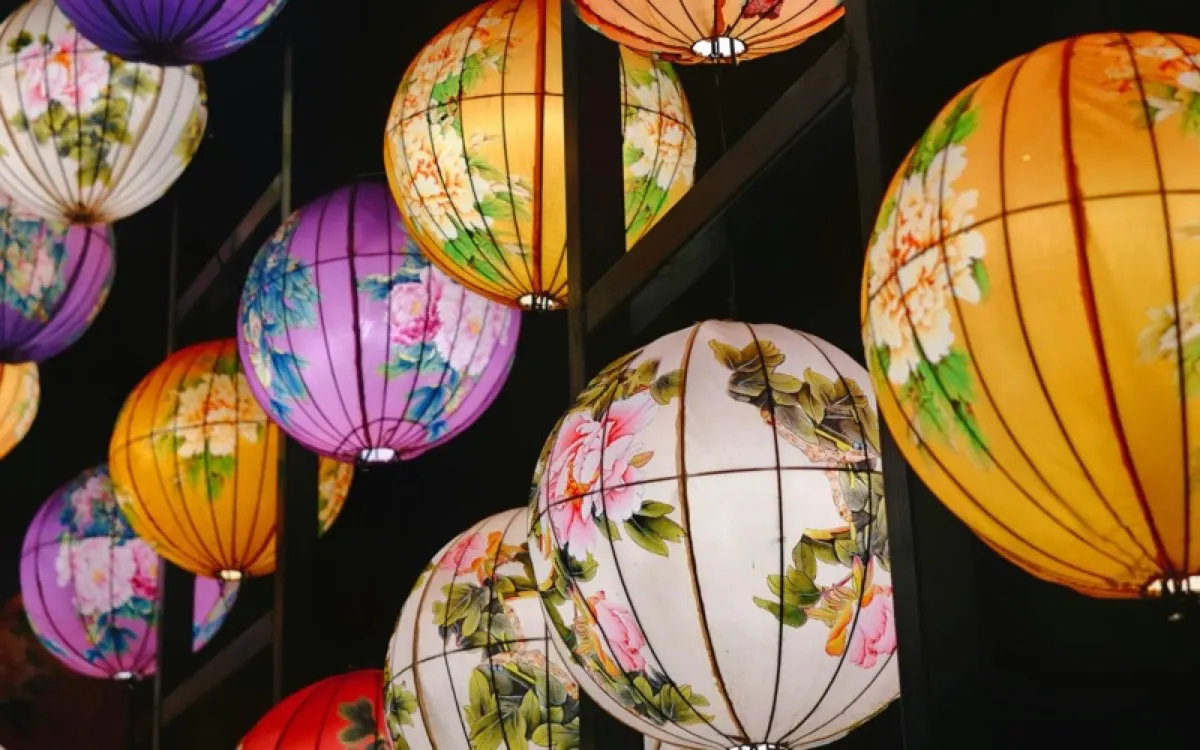
The round lantern is the most universally recognised. Its perfect sphere suggests completeness, unity and harmony — in both the visual sense and the symbolic one. It appears in the Hoi An festival imagery that has circled the world, and it is the form most immediately associated with Vietnamese craft.
The lotus shape carries the meaning of its flower: purity and spiritual clarity, something beautiful that rises from murky water without being stained by it. Lotus lanterns are common at pagodas and during Buddhist festivals, and they bring that meditative quality into any interior.
Elongated oval forms — wider in the middle, tapering at top and bottom — suggest abundance and growth. The shape implies fullness, a vessel that is generously filled. They work well in pairs flanking a doorway or along a long table.
Diamond and geometric forms are a more contemporary, architectural choice — striking on their own and dramatic in groups.
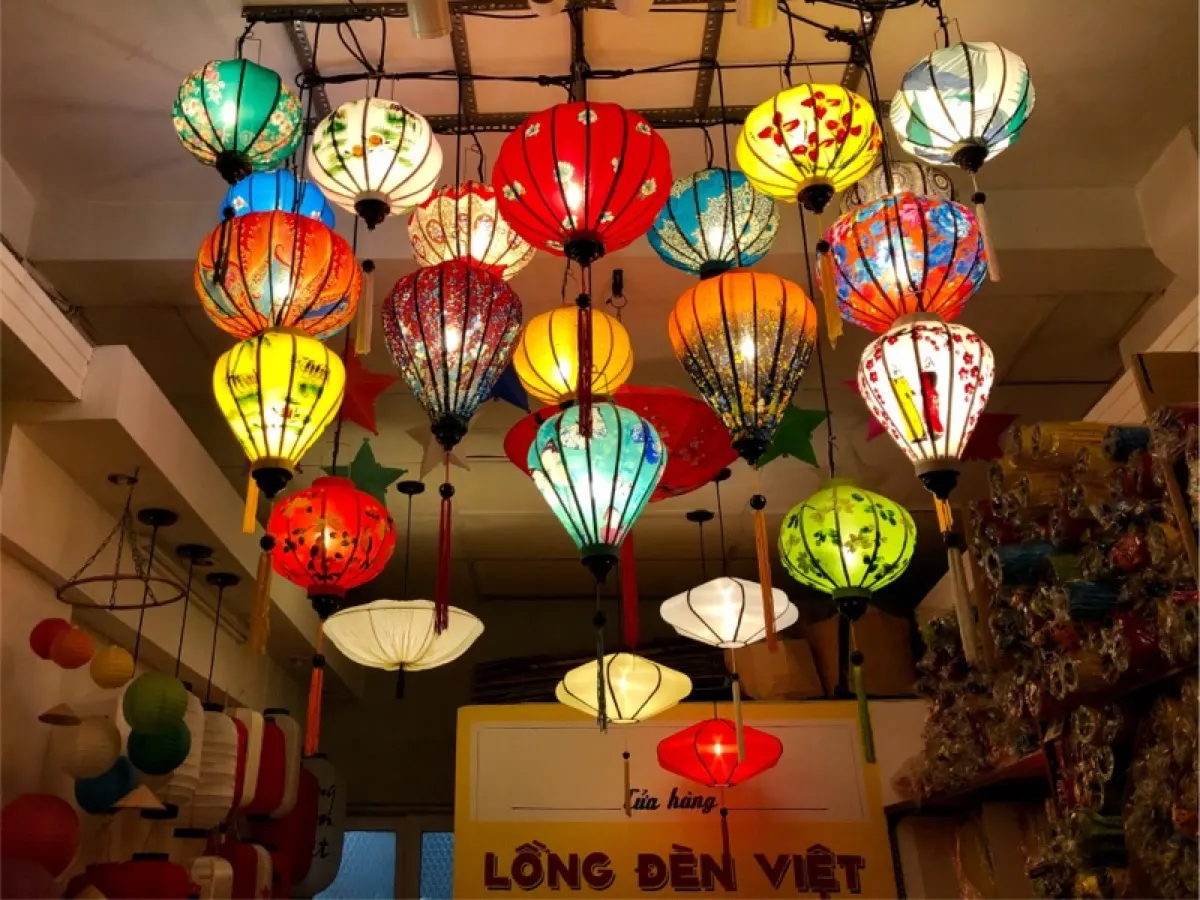
The inverted-garlic and pyramid forms — the two shapes most photographed hanging along Hoi An's riverside street — sit somewhere between the round lantern's simplicity and the lotus's specifically religious association. Their gently tapering silhouette is read as understated abundance: not the dramatic fullness of a wide oval, but a quieter sense of a form that has room inside it. This is likely why they became the default street lantern in Hoi An rather than a deliberate symbolic choice, but centuries of being the shape everyone sees in the old town have given them their own cultural weight regardless of original intent.
The flying-saucer and umbrella shapes are the newest additions to the range in symbolic terms — they read as playful and modern rather than carrying old-world meaning, which is exactly why they suit contemporary cafés, concept restaurants and children's spaces where a strict traditional read would feel out of place.
Our range
LongDenViet makes eight shapes: garlic-bulb, round, diamond, pyramid, ribbed, umbrella, flying-saucer and hexagonal wood. Each is available in all fourteen colours and sizes from 10 cm to over one metre.
A craft that grew from a meeting of three cultures at the water's edge.
Between the 15th and 19th centuries, Hoi An was one of the most active trading ports in Southeast Asia. Chinese, Japanese and later European merchants arrived and stayed — sometimes for a season, sometimes for a generation. They built warehouses and assembly halls, and they brought their customs with them, including the paper lanterns of Chinese and Japanese tradition.
Vietnamese artisans absorbed those influences and transformed them. The rigid bamboo-and-paper construction of the Chinese lantern was softened: frames became more finely split and intricately tied, and the paper covering was replaced with silk — a material traded through Hoi An itself, more luminous and far more durable in the humid coastal air.
The result was the Hoi An silk lantern: lighter, warmer in glow, collapsible for storage and travel, and distinctly Vietnamese. The craft has been refined by local families across many generations. It is not an imitation of something else — it is a genuine local invention that grew from that rare period when many cultures were genuinely in dialogue at Hoi An's port.
Today the lantern is recognised as a symbol of Hoi An and of Vietnam more broadly. The city's monthly full-moon festival, where electric lights are turned off and the old town is lit entirely by lanterns, draws visitors from every continent precisely because it is not a reconstruction — it is a living continuation of that same tradition.
The choice of silk over paper was not purely aesthetic — it was a practical response to Hoi An's climate. Coastal central Vietnam runs humid for most of the year, with a monsoon season that soaks paper lanterns until they sag and tear within a season or two. Silk, treated and stretched properly over a bamboo frame, tolerates that humidity far better, which meant a lantern hung outside a shophouse could last years rather than weeks. What began as a durability fix became the material that gave the Hoi An lantern its distinctive glow — silk diffuses light more evenly and warmly than paper, a difference immediately visible when the two hang side by side at night.
The craft also survived a period when it could easily have disappeared. Through the 20th century's wars and the economic hardship that followed, lantern-making in Hoi An persisted mainly as a household skill passed between family members rather than an organised industry — something made for temple offerings, weddings and the town's own use rather than for sale. Its revival as an export craft came later, alongside Hoi An's emergence as a UNESCO World Heritage site in 1999 and the tourism that followed, which gave the old workshops a reason to scale up production while keeping the same hand construction.
They share a common ancestor, but the construction diverged in ways you can feel with your hands.
Because both traditions trace back to the same trading-port history, the two are often assumed to be the same object with a different label. Put one of each side by side and the difference is immediate: a classic Chinese paper lantern is round, made of thin paper stretched over a wire or bamboo hoop frame, and is not designed to be folded flat. A Hoi An silk lantern is built to collapse for storage and travel — that single design choice runs through everything else about how it is made.
Colour symbolism overlaps a great deal, since both cultures draw on the same broader East Asian tradition — red for luck, gold and yellow for prosperity. Where they part ways is craft and construction: silk over a foldable bamboo frame is a specifically Vietnamese refinement that grew out of Hoi An's trading history, not a straight copy of the Chinese paper lantern that first arrived with merchants centuries ago.
Japanese chōchin lanterns entered the same trading-port mix and left their own mark, mainly in the more geometric, faceted shapes and the restrained, single-colour aesthetic seen in some Hoi An pieces today. Where Chinese influence shows up most in colour and festival use, Japanese influence shows up more in structural refinement — precise, evenly spaced ribs and a cleaner overall silhouette. The Hoi An lantern that resulted absorbed a little of both without becoming a copy of either.
How to move from symbolism to a practical decision.
The symbolism gives you useful anchors, but the choice is ultimately about the feeling you want to create in a specific space. A few starting points:
Size and quantity matter as much as colour. A single large lantern (60–80 cm) makes a focal point. A cluster of smaller lanterns at varying heights creates atmosphere. Long rows along a corridor or above a banquet table become an architectural statement.
If you are not sure where to start, browse our full range of 14 silk colours and message us on WhatsApp. We can send lit photos of any colour combination in natural and artificial light — which is far more useful than looking at flat product images when choosing something that glows. And if you want to understand the craft from the inside, you can learn to make a Vietnamese lantern yourself at our hands-on workshop.
The three variables work together — changing one changes what the whole display says.
Symbolism rarely comes from a single decision. A red lantern says one thing; a pair of red lanterns flanking a door says something more deliberate, because symmetry itself reads as intentional in a way a single piece does not. Change the shape from round to garlic-bulb and the same red pair shifts from generically festive to specifically Hoi An in character. This is why thinking about colour, shape and quantity together, rather than picking one and defaulting on the rest, produces a result that feels considered rather than assembled.
A useful way to think about it: colour sets the emotional register (luck, calm, romance, wealth), shape sets the cultural reference point (round for universal harmony, garlic-bulb and pyramid for specifically Hoi An character, diamond and saucer for contemporary), and quantity sets the formality (a single piece is a quiet accent, a symmetrical pair is a statement, an odd-numbered cluster is relaxed and social, a long row is ceremonial or architectural).
For a restaurant opening, the combination that reads most immediately across East Asian hospitality culture is a symmetrical pair of red, garlic-bulb-shaped lanterns flanking the entrance — colour for luck, shape for craft authenticity, quantity and symmetry for formality and welcome. For a wedding, an odd-numbered cluster of pink and white in a mix of round and diamond shapes reads as celebratory without being rigid. For a spa or wellness space, a single or paired green or blue round lantern communicates calm without drawing attention to itself the way a cluster would.
None of this is a rule you have to follow to the letter — plenty of beautiful, successful lantern displays break every one of these conventions on purpose. What the symbolism gives you is a starting vocabulary, so that when you do deviate from it, you are doing so as a choice rather than by accident.
Every colour below carries its own meaning. Choose the symbolism that fits your home or business — all handmade and shipped worldwide.


What does a red lantern mean in Vietnam?
Red is the colour of luck, happiness and energy. Hanging red lanterns at an entrance — especially at the start of a new year or a new business — is a way of actively inviting good fortune into a space. In feng shui terms, the lit red lantern activates Yang energy at the threshold, which is considered auspicious.
What is the most popular lantern colour in Hoi An?
Red and yellow are the colours most associated with Hoi An, and with Vietnamese festival culture generally. Red for luck, yellow for wealth and warmth. In the old town at full moon, it is predominantly these two tones you see glowing from the shophouse eaves. That said, pink, purple and white have become increasingly popular for interior design and event use in recent years.
What do the different lantern shapes mean?
Round lanterns represent completeness, unity and harmony. Lotus shapes carry connotations of purity and spiritual calm. Elongated oval forms suggest abundance — a vessel generously filled. Diamond and geometric forms are a more contemporary, architectural choice — striking on their own and dramatic in groups. In practice, the shape also determines how the light disperses: round lanterns spread an even glow, while elongated forms cast light more directionally.
Are Vietnamese and Chinese lanterns the same thing?
They share a common origin — Chinese paper lanterns came to Hoi An with merchants and settlers from the 15th century onward — but the Vietnamese version is genuinely distinct. Vietnamese artisans replaced paper with silk, which glows more warmly and lasts far longer in humid conditions. They also refined the bamboo frame to be more finely split, more intricately tied, and foldable flat for storage. The Hoi An silk lantern is its own craft, not a copy.
What is the difference between Chinese and Vietnamese lanterns?
The clearest difference is the covering and the frame. A classic Chinese lantern uses thin paper over a wire or coarser bamboo hoop, generally fixed in shape. A Vietnamese Hoi An lantern uses real silk stretched over finely split, seasoned bamboo ribs hinged at the top and bottom rings, so it folds completely flat for storage and travel. Colour symbolism overlaps, since both draw on shared East Asian tradition, but the construction is distinctly Vietnamese.
Are Hoi An lanterns Chinese?
Not in the way the paper lanterns sold for Chinese New Year are. Hoi An lanterns descend from the same trading-port history — Chinese and Japanese merchants brought paper lanterns to the port from the 15th century onward — but Vietnamese artisans transformed the craft: silk replaced paper, and the bamboo frame was refined to fold flat. What hangs over Hoi An today is a genuinely Vietnamese craft object, not an import.
When do lanterns appear most in Vietnam?
Two moments dominate the year: Tết Nguyên Đán, the lunar New Year, when red and yellow lanterns fill shopfronts and pagoda gates, and Trung Thu, the Mid-Autumn Festival, when children carry kéo quân and paper lanterns through the streets. Hoi An adds its own monthly full-moon night, on the fourteenth day of the lunar month, when the old town switches off electric lights entirely.
What does the lotus lantern shape mean?
The lotus shape carries the meaning of its flower in Buddhist symbolism: purity and spiritual clarity, something that rises clean from murky water. Lotus lanterns appear most around Phật Đản, the Buddha's Birthday, at pagodas and in homes that observe the day, bringing that meditative quality into an interior rather than a purely decorative one.
Continue reading
LongDenViet makes traditional bamboo-and-silk lanterns in eight shapes and fourteen colours, sized from 10 cm to over one metre. Logo printing available. We ship worldwide via DHL and FedEx — flat-packed, so freight stays reasonable.
Visit our showroom
262/1/93 Phan Anh, Phu Thanh Ward, Tan Phu District, Ho Chi Minh City
Air-conditioned, one-on-one help, English spoken. Open daily 8 a.m.–9 p.m.