

Contact us
Free · We reply within 15 minutes
Danh mục
More
Contact us
Free · We reply within 15 minutes
Vietnamese Festivals
Updated August 2026 · By the LongDenViet workshop, Ho Chi Minh City
Tet 2027 falls on 6 February — the first day of the lunar new year, and by far the biggest holiday on the Vietnamese calendar. Weeks before it arrives, houses, shopfronts and restaurants across the country start looking distinctly festive.
If you are decorating for Tet in Vietnam, or shopping for someone who is, this guide covers what traditional Tet decorations actually look like here, how the holiday differs from Chinese New Year despite sharing a calendar, the colours that dominate every street, and the embroidered lanterns we make with real Vietnamese Tet phrases stitched onto them.
Every date and price below is the same one our workshop quotes from — nothing here is rounded up or guessed at for the sake of a tidy sentence.
The date shifts every year with the lunar calendar.
Tet 2027 — the first day of the lunar new year — falls on Saturday, 6 February 2027. Vietnamese households typically start decorating roughly two to three weeks beforehand, during the lunar twelfth month known as thang Chap, rather than waiting until the eve itself.
There is no single fixed day everyone puts decorations up on, the way some countries mark a specific date for it. Families and shop owners tend to decorate whenever the mood, the market stalls and the cleaning schedule line up — often the same week they buy their kumquat tree or peach blossom branch.
The lead-up to Tet is also when a Vietnamese household does its biggest annual clean of the year, known as don nha don Tet — clearing clutter, repainting where needed, and settling any outstanding debts before the new year begins. Decorating comes right after that clean rather than before it, on the logic that a fresh, tidy home is what the lanterns and blossom are meant to be hung inside, not layered on top of a house still mid-clear-out.
Ram thang Gieng, the full moon of the first lunar month, is when a lot of households take their Tet decorations down and make a final visit to the pagoda for the year's first full-moon prayers. Between the two dates, decorations tend to stay up rather than come down and go back up — once the lanterns, kumquat tree and blossom branch are in place, they hold their spot through the entire fortnight.
Same lunar calendar, a distinctly Vietnamese set of customs.
Tet and Chinese New Year fall on the same date most years, because both follow the same lunar calendar system. That is where the overlap mostly ends. Vietnamese Tet has its own customs built up over centuries: red lucky money envelopes (li xi) given to children and elders, a five-fruit tray (mam ngu qua) arranged on the ancestor altar, and — this is the regional split that surprises a lot of visitors — yellow apricot blossom (hoa mai) decorating homes in the south, while peach blossom (hoa dao) is the equivalent in the north.
None of this is identical to how Chinese New Year is decorated or celebrated elsewhere in the region. Calling it "Vietnamese New Year" instead of Chinese New Year, when talking about Tet specifically, is simply more accurate.
The distinction matters most to Vietnamese people themselves, who tend to notice — and sometimes gently correct — a foreigner defaulting to "Chinese New Year" for a holiday their own family has celebrated with its own specific customs for generations. It costs nothing to use the correct name, and it is one of the small courtesies that goes further with hosts and colleagues than most visitors expect.
The kumquat tree deserves its own mention, since it is one of the details that has no real equivalent elsewhere: a small potted citrus tree, heavy with round orange fruit, placed at the entrance of nearly every Vietnamese home and shopfront in the weeks around Tet. It is chosen for the abundance the loaded branches suggest, and a well-shaped, fruit-heavy tree is genuinely something people shop around for, the way others might shop for a Christmas tree.
The five-fruit tray carries its own logic too, one that shows how Tet customs vary even within Vietnam. In many southern households the tray leans on a well-known pun: custard apple, coconut, papaya and mango, whose names strung together sound close to a common Vietnamese phrase wishing for "just enough to get by" for the year ahead. Northern households build the tray differently, often around banana, pomelo, persimmon and tangerine instead, without leaning on that same wordplay. Neither version is more correct than the other — they are simply two regional traditions that grew up around the same holiday.
Workplaces run their own version of the gift-giving that surrounds Tet. Companies commonly hand out a year-end bonus known as thuong Tet, and managers often give li xi envelopes to junior staff on the first working day back, inverting the usual pattern of adults giving to children. A branded gift basket, a bottle of good wine or an embroidered lantern for a valued client or supplier is a common gesture in the weeks leading up to the holiday — arriving too close to Tet itself is considered less thoughtful than sending it during thang Chap, while offices are still fully staffed and not yet closing down for the break.
Red and gold lead, but the blossom colours split the country in two.
Walk down almost any street in Vietnam in the two weeks before Tet and the palette is immediately recognisable: red banners, gold trim, and — depending which half of the country you are in — either yellow apricot blossom or pink peach blossom filling every flower stall.
This is also why our embroidered lantern set leans so heavily on red silk: it is the one colour that reads correctly as Tet decor in every region, whereas a blossom-coloured lantern would look distinctly southern or northern depending on the shade chosen.
Flower markets in the weeks before Tet run almost entirely on this same palette. Branches of real apricot or peach blossom, sometimes an entire small tree of one or the other, sell alongside artificial versions for households that want the look without the week-long wilting real branches are prone to indoors. Red and gold paper couplets, calligraphy scrolls wishing prosperity or longevity, and strings of red firecracker-shaped decorations round out what a typical flower-market stall sells alongside the blossom itself.
Gold rarely appears alone. It is almost always a trim, an edge or an accent against a red field — gold tassels on a red lantern, gold thread in an embroidered phrase, gold characters on a red paper couplet — rather than a colour that carries a whole decoration by itself. Red does that work, with gold there to lift it rather than compete with it.
Each one carries a real Vietnamese Tet greeting, not a generic decorative pattern.
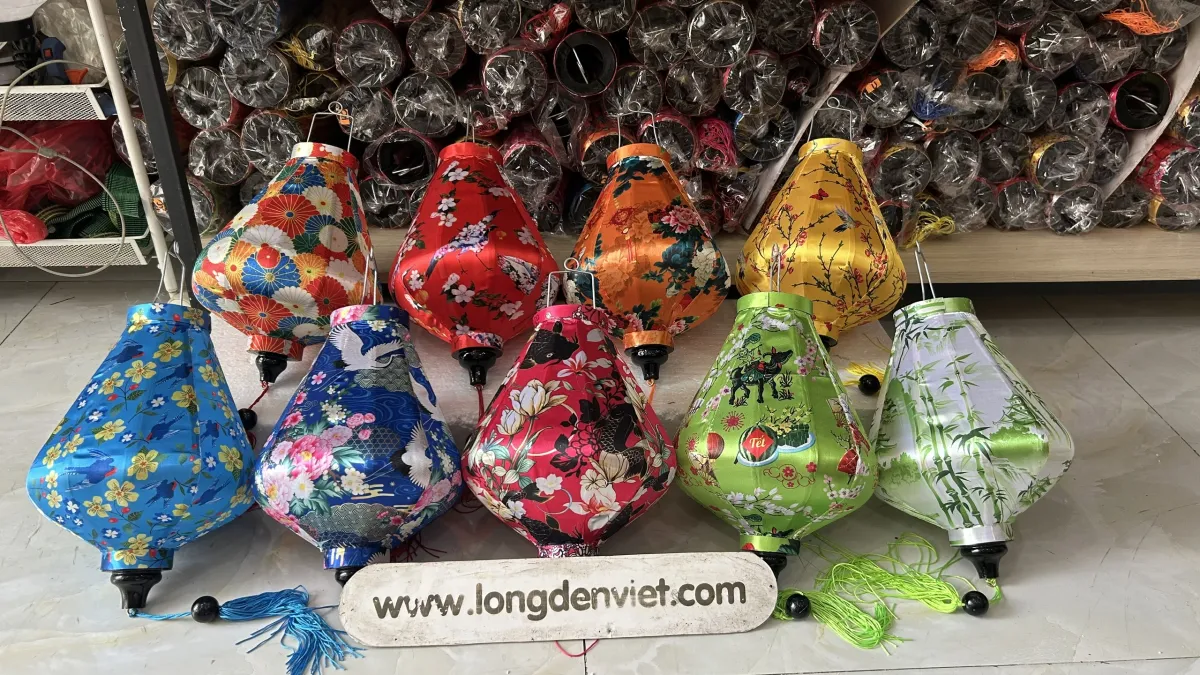
Red lanterns are one of the most recognisable Tet decorations in Vietnam, hung at front doors, over shopfronts and along restaurant balconies. Ours are silk over a bamboo frame, hand-embroidered with a genuine Vietnamese new-year phrase rather than a decorative pattern picked for looks alone.
The Hoa Mai design costs a little more than the rest — the apricot-blossom embroidery takes longer to stitch than a text phrase does. Every other design in the set is priced the same regardless of which greeting it carries.
A word on picking a phrase rather than defaulting to Happy New Year: An Khang Thinh Vuong reads as a wish for good health as much as prosperity, which suits a lantern given to an older relative. Van Su Nhu Y is closer to a general "may things go your way," which works well as a gift with no specific recipient in mind. Phuc Loc Tho names three separate blessings — fortune, prosperity and long life — and is the phrase most often chosen for a business or shopfront rather than a private home.
Each phrase is stitched by hand onto the stretched silk before the fabric goes onto the bamboo frame, character by character rather than run through as one machine pass. That is the detail that keeps the Vietnamese diacritics — the accents that change a word's tone and meaning entirely — crisp under the lantern's internal light instead of blurring the way a printed design tends to once the fabric is pulled taut over curved ribs. Getting the diacritics wrong on a printed lantern is a common complaint about mass-produced Tet decor; a hand-embroidered phrase does not have that problem because a person, not a printer, is following the exact characters.
Front doors and balconies see the most use, but restaurants and offices buy them too.
A door pair is worth getting right in one specific way: the two lanterns should carry either the same phrase or two phrases that read well as a pair, such as An Khang Thinh Vuong on one side and Chuc Mung Nam Moi on the other, rather than two unrelated designs picked at random.
Streets that lean fully into Tet decorating — certain flower-market corridors and older commercial strips in particular — will sometimes hang a continuous run of red lanterns the length of the whole block, coordinated between neighbouring shopfronts rather than each owner decorating independently. That coordinated look, more than any single household's decoration, is what tends to end up on postcards and in tourism photography of Tet in Vietnam.
You do not need to read Vietnamese to get the meaning right.
If you live in Vietnam or are visiting around the new year and want decorations that mean something rather than a generic red lantern from a decor aisle, the embroidered phrase is the detail that makes the difference — and we translate every one of them for you before you order, so you know exactly what you are hanging on your door.
We ship nationwide within Vietnam and internationally by courier for anyone celebrating Tet abroad. Message us on WhatsApp with the phrase and quantity you want, and we confirm the real shipping cost and timeline for your address.
For anyone buying as a gift for a Vietnamese friend, colleague or in-law rather than for their own front door, An Khang Thinh Vuong and Phuc Loc Tho are the two safest choices — both are broad, respectful wishes rather than anything narrowly personal, and neither one risks the slightly odd tone a mistranslated phrase can carry.
Expats living in Vietnam long-term sometimes ask whether hanging Tet decorations as a non-Vietnamese household reads as appropriate or presumptuous. In practice it is neither — decorating for Tet the way any neighbour does is generally read as a sign of respect for the country you are living in, not an appropriation of a custom that is not yours to take part in. Vietnamese neighbours and landlords, in our experience, tend to react warmly rather than awkwardly when a foreign-run household or business joins in with the same red lanterns and kumquat tree everyone else on the street has out.
One last practical note for anyone ordering close to the holiday: courier networks slow down in the final week before Tet as the whole country effectively takes leave at once, staff included. Ordering with at least two to three weeks of buffer before 6 February 2027 avoids the scramble that hits anyone trying to get decorations delivered the same week offices and courier depots start closing for the break.
Vietnam largely comes to a standstill during Tet itself — shops, offices and most courier services close for anywhere from three days to a week, depending on the business. Anyone travelling or living here for their first Tet should plan errands and deliveries around that closure rather than assuming services will run as normal through the holiday the way they might around a single public holiday elsewhere.
Silk lanterns hand-embroidered with real Vietnamese new-year greetings, translated for you before you order.


When is Tet 2027?
Tet 2027 — the first day of the Vietnamese lunar new year — falls on Saturday, 6 February 2027.
Is Tet the same as Chinese New Year?
They share the same lunar calendar date most years, but Tet in Vietnam has its own customs: red lucky-money envelopes, a five-fruit altar tray, and apricot blossom in the south versus peach blossom in the north. It is more accurate to call it Vietnamese New Year than Chinese New Year.
What are traditional Tet decorations?
Red embroidered lanterns at doors and balconies, apricot blossom (hoa mai) in southern Vietnam or peach blossom (hoa dao) in the north, a kumquat tree, and a five-fruit tray on the ancestor altar are among the most common.
When should I put up Tet decorations?
Most Vietnamese households decorate roughly two to three weeks before Tet, during the lunar twelfth month. There is no single fixed date — it varies by household.
Where can foreigners buy Tet decorations in Vietnam?
We make embroidered Tet lanterns at our workshop in Ho Chi Minh City, translate every Vietnamese phrase for you, and ship nationwide or abroad. Message us on WhatsApp with the phrase and quantity you need.
What does ram thang Gieng mean and when is it in 2027?
Ram thang Gieng is the full-moon day of the first lunar month, the 15th day of the same lunar month as Tet — 20 February 2027. It marks the informal end of the Tet season for many households, when decorations tend to come down.
What do the colours in Tet decorations mean?
Red signals luck and protection and is the most common colour for Tet lanterns and banners. Gold pairs with it for prosperity. Apricot yellow echoes hoa mai blossom in the south, and peach pink echoes hoa dao blossom in the north.
Which embroidered lantern phrase should I choose as a gift?
An Khang Thinh Vuong (health and prosperity) and Phuc Loc Tho (fortune, prosperity, longevity) are the safest general-purpose choices for a gift, since both are broad, respectful wishes rather than anything narrowly personal.
Continue reading
Red silk lanterns hand-embroidered with real Vietnamese new-year phrases, translated for you, made in our Ho Chi Minh City workshop.
Visit our showroom
262/1/93 Phan Anh, Phu Thanh Ward, Tan Phu District, Ho Chi Minh City
Air-conditioned, one-on-one help, English spoken. Open daily 8 a.m.–9 p.m.